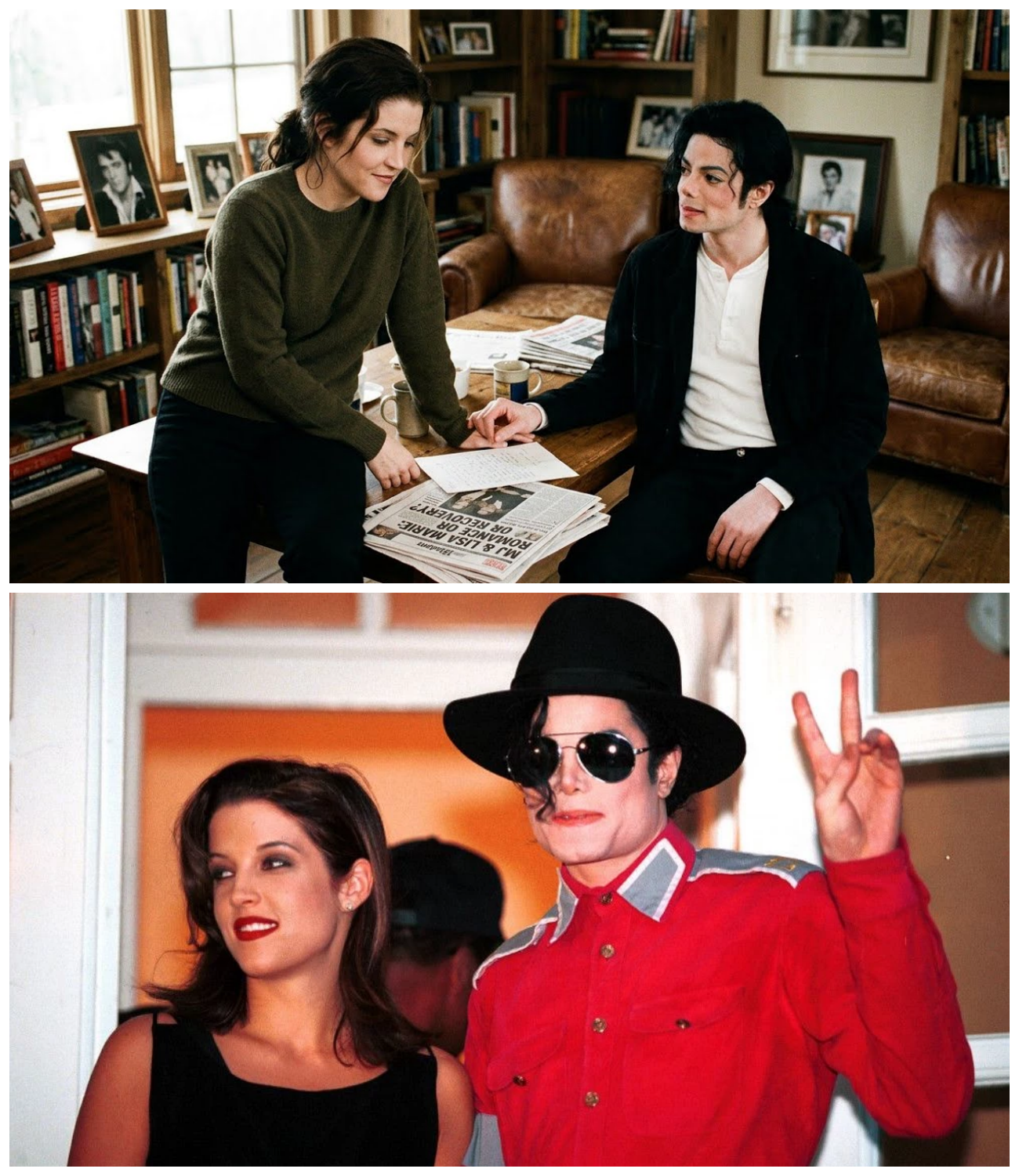
In May 1994, the world woke up to news that made no sense to most people. Lisa Marie Presley, the only daughter of Elvis Presley, had quietly married Michael Jackson in a private ceremony in the Dominican Republic. No press, no announcement, no warning. Just two of the most famous names in music history suddenly husband and wife.
People assumed it was fake, a publicity stunt, a distraction from the child abuse allegations Michael was facing at the time. But Lisa Marie had a different story. She said she genuinely fell in love with him. She said she thought she could help him. And she said walking away was one of the hardest things she ever did.
So what really happened between these two? And why did a woman who grew up watching her own father destroy himself with drugs and fame walk straight into the arms of a man going through the same thing? It started in Las Vegas in 1975. Elvis Presley was in the middle of one of his residency runs at the Las Vegas Hilton, performing the kind of shows that still drew massive crowds even as his health was quietly declining behind the scenes.
After one of those performances, Elvis brought his 8-year-old daughter Lisa Marie backstage. It was a normal thing for him to do. He wanted her close, wanted her to see his world, and the backstage area after a show was always full of people, musicians, managers, friends, and occasionally other celebrities who had come to watch.
That night, one of those people was a 16-year-old Michael Jackson. The Jackson 5 were already famous by that point. Michael had been performing professionally since he was a child, and by 1975, he was one of the most recognizable young musicians in America. He was at the show as a fan because Elvis was someone Michael genuinely admired.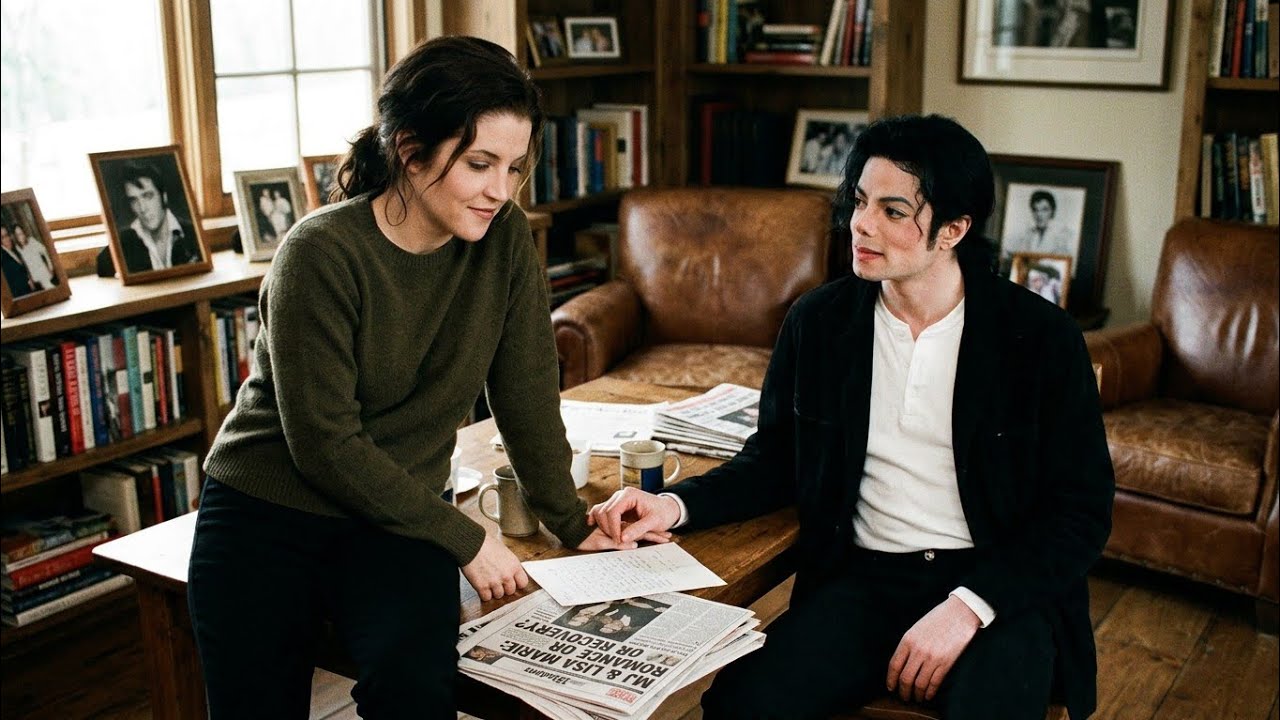
The two families crossed paths briefly backstage. Lisa Marie was a child, Michael was a teenager, and the meeting lasted only a few minutes before everyone moved on. Neither of them could have known what that brief introduction would eventually become. For the next 15 years or so, their lives ran on completely separate tracks. Lisa Marie grew up at Graceland, lost her father in 1977 when she was nine, inherited one of the most famous estates in America before she was old enough to fully understand what that meant, and carried the particular kind of grief
that comes from watching a parent disappear slowly before they actually die. Michael went on to become the biggest solo pop star in the world, released Thriller in 1982, and built a level of fame that very few people in history have ever experienced. By the early 1990s, both of them had reached a point in their lives where the people around them were rarely honest with them.
That is something that happens at a certain level of fame. Everyone wants something. Everyone has a reason to tell you what you want to hear. Real conversation becomes rare. Real connection becomes even rarer. Sometime around 1992, they reconnected through mutual contacts. The exact details of how it happened have never been fully public, but what is known is that they began talking on the phone, and those phone calls were long.
Lisa Marie has spoken about this in interviews over the years, and the detail she always comes back to is how different Michael was in private compared to everything she had seen of him publicly. He was funny. He was sharp. He asked questions and actually listened to the answers. He was not performing for her the way he performed for the rest of the world.
For Lisa Marie, this was significant. She had grown up surrounded by people who performed. Her father performed. The the around her father performed. She had developed a very good sense of when someone was being real with her and when they were not. And in those early conversations with Michael, she felt like she was talking to someone who was genuinely present.
From Michael’s side, Lisa Marie represented something equally rare. She was someone who understood what it meant to grow up inside extraordinary fame without choosing it. She had been Elvis Presley’s daughter from the moment she was born. She had never known a version of life where her last name did not mean something massive to every person she encountered.
Michael had lived his entire life as a public figure, but he had started choosing that life as a very young child. Lisa Marie had never had a choice, either. That shared experience of fame without consent was something almost nobody else in the world could truly relate to. The phone calls continued for months. They moved from phone calls to visits.
The friendship deepened, and somewhere in that process, the nature of the relationship shifted. By the time 1993 arrived, they were genuinely close. Not publicly, not in any way the outside world could see, but privately, something real had formed between two people who both had spent most of their lives being surrounded by everyone while feeling understood by almost no one.
That is where the story of their relationship actually begins. Not in a church or a courthouse or a headline. It begins in a backstage hallway in Las Vegas in 1975 and in the quiet space of late-night phone calls almost two decades later, where two of the most famous people alive finally felt like they could just talk.
By 1993, Michael Jackson had already achieved something that very few artists in history ever reach. He was not just famous. He was the kind of famous that transcends music entirely and becomes something closer to a global phenomenon. Thriller had become the best-selling album of all time.
The Dangerous Tour was running to sold-out stadiums across the world. His face was on magazine covers in countries where people did not even speak English. He had built Neverland Ranch in Santa Barbara, a 2,700 acre property with its own amusement park, zoo, and movie theater. And he lived there largely removed from ordinary life.
From the outside, 1993 looked like another peak year for Michael Jackson. From the inside, it was the year everything began to break. The first crack appeared in the form of a civil lawsuit. In August 1993, Evan Chandler, the father of 13-year-old Jordan Chandler, alleged that Michael had sexually abused his son.
The accusation hit the public like a shockwave. Michael was at a level of fame where people had genuinely placed him in a category beyond ordinary human behavior. And now, here was a claim that forced everyone to look at him differently. The media coverage was immediate and overwhelming.
Every tabloid, every news channel, every radio station was running the story. Michael denied the allegations completely, but the legal process moved forward regardless of what he said publicly. His home was searched. His body was examined by investigators looking for physical evidence. That examination alone, being photographed and scrutinized in that way, was described by people close to him as something that devastated him psychologically in a way that very little else could have.
The case never went to criminal trial. In early 1994, the Chandler family accepted a civil settlement reported at around $23 million. No admission of guilt was part of that settlement, and Michael maintained his innocence. But the damage to how the public perceived him was already done. For a man who had built his entire identity around being loved universally, the idea that a significant portion of the world now looked at him with suspicion was something he struggled to process.
What made it worse was what was happening to his body at the same time. This part of the story goes back further than 1993. In January 1984, Michael was filming a Pepsi commercial when a pyrotechnics malfunction caused his hair and scalp to catch fire. He suffered second and third-degree burns to his scalp.
The physical pain from that injury led to his introduction to prescription painkillers, and the dependency that started there never fully resolved. Over the years, the use of these medications had grown and shifted, managed by various doctors, largely hidden from public view. By 1993, the stress of the allegations made everything worse.
He was using more, sleeping less. The tour was eventually suspended. In November 1993, Michael released a televised statement from Neverland in which he looked visibly unwell, reading from a prepared script, his voice strained. He spoke about the body examination. He described it as humiliating and dehumanizing. Anyone watching could see that this was not a performance.
This was a person in genuine distress. He checked into a rehabilitation facility in London towards the end of 1993, citing addiction to prescription painkillers. It was one of the few times in his career that something deeply private became unavoidably public. This was the version of Michael Jackson that Lisa Marie Presley was talking to during this entire period, not the global icon on the Dangerous tour poster, not the entertainer who could hold 100,000 people in the palm of his hand.
She was talking to someone who was frightened, in pain, increasingly isolated, and surrounded by people who were either unable or unwilling to be honest with him about what they were watching happen. Lisa Marie was neither unable nor unwilling. She had seen this pattern before. She had watched it with her own father.
She knew what prescription drug dependency looked like from the inside of a family, knew what it did to a person over time, and knew how the people around famous man often made it worse rather than better. She did not pull back from Michael when the allegations hit, and when his struggles became visible. She moved closer, and that decision to stay and to engage rather than to walk away is what turned a deepening friendship into something more serious by the time 1994 arrived.
To understand why Lisa Marie Presley made the choices she made with Michael Jackson, you have to go back to her childhood. Not the version of her childhood that looks glamorous from the outside, growing up at Graceland, being the daughter of the most famous musician in America, having access to everything money could provide.
You have to look at what that childhood actually felt like from the inside, because that is where everything that came later begins to make sense. Lisa Marie was born on February 1st, 1968 in Memphis, Tennessee. She was Elvis and Priscilla Presley’s only child. From her first day of life, her name meant something to the entire world.
She did not grow into fame gradually the way some children of celebrities do. She was born into the center of it. Elvis Presley in 1968 was already a legend, and his daughter was treated as an extension of that legend from the moment she arrived. Her parents separated when she was four and divorced when she was five. Priscilla took primary custody and moved with Lisa Marie to Los Angeles.
Elvis remained at Graceland in Memphis. What this meant practically was that Lisa Marie spent her childhood moving between two very different worlds. In Los Angeles with her mother, life was more structured, more private, more controlled. In Memphis with her father, life was Graceland, a house full of people at all hours, a father who was adored by everyone around him, and an atmosphere that was simultaneously exciting and deeply unstable.
Elvis, by the early 1970s, was already struggling. The prescription drug use that would eventually kill him had been building for years. The people around him, the Memphis Mafia as they were known, were loyal to him, but rarely challenged him. They enabled more than they intervened. Lisa Marie was a child in that environment, old enough to feel that something was wrong, young enough to not have the language to fully understand what she was seeing.
She has spoken in interviews about specific memories from that time, watching her father in states that confused her, sensing the tension between the version of Elvis the world celebrated and the version she saw privately. Children in those situations often develop a heightened sensitivity to mood and behavior.
They learn to read rooms quickly. They become attuned to the difference between what adults say and what is actually happening. Lisa Marie grew up that way, observant, perceptive, and carrying more emotional weight than any child should have to carry. Elvis Presley died on August 16th, 1977. Lisa Marie was 9 years old.
He was found unresponsive at Graceland and could not be revived. The official cause was cardiac arrhythmia, but the years of prescription drug use had destroyed his body from the inside. He was 42 years old. 9 years old is old enough to understand that your father is gone and young enough that the full weight of what that means takes decades to process.
Lisa Marie inherited Graceland and a substantial estate held in trust until she turned 25. She also inherited the grief, the complexity, and the unresolved questions that come with losing a parent to a slow and preventable decline. Her teenage years were difficult. She has been open about going through her own struggles during that period, experimentation, searching for stability, trying to build an identity that was separate from the name she carried.
At 20, she married musician Danny Keough. They had two children together, a daughter named Danielle and a son named Benjamin. The marriage lasted 4 years before they divorced in 1994. By the time Lisa Marie was having those long phone calls with Michael Jackson in 1992 and 1993, she was a 24 and 25-year-old woman who had already lived through more emotional complexity than most people encounter in a lifetime.
She had lost her father to addiction. She had been through a marriage and a divorce. She was raising two young children. She was managing an enormous inheritance and the public expectations that came with the Presley name. She was not someone who could be easily fooled about what pain looked like in another person.
She was not someone who romanticized struggle without understanding its cost. When she looked at Michael Jackson in 1993 and saw someone brilliant and isolated and heading towards a familiar kind of destruction, she was not seeing it as an outsider. She was seeing it as someone who had watched that exact story before and had spent her whole life wishing she could have changed how it ended.
>> By early 1994, Lisa Marie Presley and Michael Jackson had been talking regularly for over a year. The phone calls had turned into visits. The visits had turned into something neither of them had publicly acknowledged, but both of them clearly understood. They were close in a way that went beyond friendship, and the people immediately around both of them knew it, even if the rest of the world had no idea.
Michael proposed to Lisa Marie in early 1994. The proposal was not a grand public gesture. It was private, direct, and came after months of conversations in which Michael had made clear that he wanted her in his life in a permanent way. Lisa Marie did not say yes immediately. She has talked about this in interviews, that she took time to think about it, that she was aware of how the world would react, and that she asked herself seriously whether this was something she actually wanted or something she was being pulled into.
She said yes, and the decision was entirely hers. That point matters because from the moment the marriage became public, the dominant narrative was that Lisa Marie had been used, that Michael needed a wife to improve his image in the middle of the child abuse allegations, and that she was either naive enough to not see that or willing to go along with it for reasons of her own.
That narrative was loud, and it was persistent, and it followed the marriage from the day it was announced until long after it ended. Lisa Marie pushed back against that version of events consistently and directly. She was not someone who struggled to express herself or who avoided difficult questions in interviews.
When people suggested the marriage was a strategy, she did not deflect or soften her response. She said flatly that she loved him, that she made her own decision, and that anyone who reduced the relationship to a publicity arrangement did not know what they were talking about. What she has described instead is a genuine belief that she and Michael had a real connection built over a long period of private conversation and time spent together away from the public eye.
She felt that she understood him in a way that most people in his life did not, and she felt that he understood something about her life and her experience that very few others could. There was also the other thing, the thing she has been more careful about saying directly, but which runs underneath everything she has described about this period.
She believed she could help him. She could see what was happening with his health and his dependency on prescription medications, and she believed that being close to him, being a stable and honest presence in his life could make a difference. She had watched her father surrounded by people who told him what he wanted to hear until it was too late.
She was not going to be that person for Michael. She was going to be honest with him even when it was uncomfortable, and she believed that was what he needed. Her family and close friends were not enthusiastic about the marriage. The concerns were understandable. Michael was in the middle of one of the most damaging public scandals of his career.
The timing looked suspicious to people on the outside, and anyone who cared about Lisa Marie had reason to worry about what she was walking into. But Lisa Marie had spent her entire life making decisions inside a set of circumstances that most people could not fully understand from the outside. She was used to the gap between how things looked publicly and what was actually happening privately.
She trusted her own judgment over the opinions of people who were working from incomplete information. They married on May 26th, 1994 in La Vega, Dominican Republic. The ceremony was small, quiet, and completely private. No media, no announcement, no spectacle. The public found out weeks later, and the reaction was immediate and overwhelming.
Confusion, skepticism, mockery, and genuine shock in equal measure. None of that changed what Lisa Marie already knew. She had made her decision with full awareness of what she was choosing, and she was prepared to stand by it regardless of what the world thought about it. When Lisa Marie Presley moved into Neverland Ranch after the wedding, she entered a world that was unlike anything most people could picture.
Neverland was not simply a large house. It was a self-contained environment that Michael had built specifically to separate himself from the outside world. There was an amusement park with functioning rides. There was a zoo with exotic animals. There were movie theaters, candy shops, and sprawling grounds that went on for miles.
It was designed to feel like a place where normal rules did not apply, where the outside world and everything difficult about it simply could not reach you. For Michael, Neverland was safety. It was control. It was a place he had built entirely on his own terms and filled with things that made him feel protected.
For Lisa Marie, it was something more complicated. She has described moments of genuine happiness during this period, times when she and Michael were simply two people living privately, away from cameras and public pressure, finding the kind of ordinary rhythm that most couples take for granted, cooking together, watching movies, talking late into the night the way they had done on the phone before the marriage.
She has said those moments were real and that the connection she felt with him during that time was real. But Neverland also had another side that became impossible to ignore the longer she was there. Michael was surrounded by a large staff and a circle of associates, managers, and advisers who had built their entire professional lives around his continued cooperation.
These were people whose income, whose influence, and whose access to one of the most powerful figures in entertainment depended entirely on staying in Michael’s good graces. That dynamic created an environment where very few people were willing to tell Michael anything he did not want to hear. Lisa Marie noticed this quickly.
She has spoken about watching interactions between Michael and the people around him and seeing a consistent pattern, agreement, flattery, and the careful avoidance of anything that might cause friction. She found it deeply uncomfortable. She had grown up watching the same dynamic destroy her father, and she understood exactly what it produced over time.
It produced a person who lost touch with reality gradually because nobody around them was providing an honest reflection of what was actually happening. She tried to be that honest reflection for Michael. She pushed back when she disagreed with him. She raised concerns about the people she felt were not acting in his genuine interest.
She addressed the medication use directly, telling him that what she was seeing worried her, and that she wanted him to get help. These were not easy conversations, and Michael did not always respond to them well. He was not used to the people closest to him challenging him, and there were times when Lisa Marie’s directness created real tension between them.
The prescription medication dependency was the central issue that ran through the entire marriage. Lisa Marie could see it clearly. She knew the signs from her own experience watching Elvis, and what she was observing in Michael matched that pattern in ways that frightened her. The amounts were increasing.
The behavior that accompanied the use was becoming more visible. There were people in Michael’s circle who were facilitating the access to these medications rather than helping reduce it, and Lisa Marie felt powerless to override the influence those people had over him. She has described a specific and painful frustration during this period, the frustration of being present, of being willing, of genuinely trying to reach someone, and watching them choose the version of their life that was destroying them anyway.
She could not force Michael to change. She could only make the choice available to him and watch what he did with it. Outside of Neverland, the public marriage was its own separate experience. Every appearance they made together was analyzed and dissected. The famous kiss at the 1994 MTV Music Awards, Michael leaning toward Lisa Marie and asking the audience if they wanted to see something that everyone said could not happen, was watched and rewatched and debated endlessly.
Were they performing? Was it genuine? Nobody outside that relationship could say for certain. What is certain is that inside the marriage, away from the cameras and the commentary, Lisa Marie was fighting a quiet and losing battle to save someone who was not yet ready to be saved. Lisa Marie Presley filed for divorce in August 1996.
The marriage had lasted 20 months. From the outside, the end of it looked like confirmation of everything the skeptics had said from the beginning, that it was never real, that it was always temporary, that two people that famous and that different could not possibly have built something genuine. The tabloids treated the divorce as the final proof of a story they had already decided was a fraud.
That reading was wrong, and Lisa Marie spent years making that clear in interviews whenever the subject came up. The marriage ended not because it was fake, but because of something more painful than that. It ended because something real had failed, and the reason it failed was specific. Michael was not getting better.
He was getting worse. The prescription medication dependency that Lisa Marie had been watching and confronting throughout the marriage had not responded to anything she tried. She had raised it directly with him more times than she could count. She had expressed her fear about where it was heading.
She had pushed back against the people in his circle who she believed were making the situation worse rather than better. None of it had moved him toward change in any lasting way. There would be periods where things seemed to stabilize, where Michael seemed more present and more engaged, and then the cycle would pull back in the other direction.
Lisa Marie has described the moment she understood the marriage was over as a specific internal recognition, rather than a single dramatic event. It was not one argument or one incident that ended things. It was the accumulation of evidence that she could not change what was happening, and that continuing to try was not going to produce a different result.
She had reached the limit of what love and proximity and honesty could do when the other person was not ready to meet those things with a genuine commitment to change. There is a particular kind of grief that comes with that recognition. It is different from the grief of losing someone who wanted to be saved and could not be.
It is the grief of watching someone who had the ability to choose differently, and was not choosing differently, and understanding that you cannot make that choice for them, no matter how clearly you can see what it is costing them. Lisa Marie knew that grief from her childhood. She had felt a version of it watching Elvis.
Now she was feeling it again, older and more aware of what it meant, and equally powerless to change the outcome. She has also spoken about the people surrounding Michael as a significant factor in why the marriage could not sustain itself. Neverland was Michael’s world, built on his terms, staffed by people whose loyalty was to him in a way that made genuine outside influence nearly impossible to maintain over time.
Lisa Marie was an outsider in that environment, regardless of the fact that she was his wife. The infrastructure around Michael was not designed to accommodate someone who challenged the existing dynamic, and the longer she was there, the more clearly she could feel that resistance working against everything she was trying to do.
The divorce was finalized in 1996. Lisa Marie has said she carried the failure of that marriage for a long time afterward. Not the failure of something that was never real, but the failure of something she had genuinely invested herself in and could not make work. That distinction mattered to her.
She was not mourning a performance, she was mourning an actual loss. What makes this section of the story particularly heavy is what came after. The years following the divorce did not produce the course correction that Lisa Marie had hoped leaving might force. Michael’s situation continued to deteriorate. The dependency deepened.
The people around him changed, but the pattern did not. And Lisa Marie watched all of that from a distance, carrying the specific weight of someone who had tried to intervene early, had seen clearly where things were heading, and been unable to stop it. She had told him the road he was on led to.
He had not listened, and the road continued in exactly the direction she had warned him about. Michael Jackson died on June 25th, 2009. He was 50 years old. The official cause of death was acute propofol and benzodiazepine intoxication, administered by his personal physician Conrad Murray, who was later convicted of involuntary manslaughter.
Michael had been in rehearsals for his This Is It comeback concert series at the time. 50 shows scheduled at the O2 Arena in London that were supposed to mark his return to the stage after a long absence. He never made it to opening night. The news broke in the afternoon on the West Coast of the United States and spread across the world within minutes.
The reaction was immediate and massive. Fans gathered outside hospitals and at Neverland. Television networks interrupted regular programming. The internet came close to collapsing under the weight of people searching his name simultaneously. For an entire generation, it was one of those moments where people remember exactly where they were when they heard.
Lisa Marie was not part of Michael’s daily life by that point. They had been divorced for 13 years. She had remarried twice after the divorce. First to musician John O’s a Jaka briefly, then to actor Nicholas Cage for a short marriage, and then to musician Michael Lockwood with whom she had twin daughters. Her life had moved forward in the way lives do, but Michael had never fully left the space he occupied in her history, and his death landed on her with a weight that was specific and complicated in ways that a
straightforward loss would not have been. A few days after Michael died, Lisa Marie published a blog post. It was not a polished press release written by a publicist. It was personal and direct and clearly written in her own voice. She described the grief she was feeling, but she also described something harder than grief.
The feeling of having known this was coming and having been unable to stop it. She wrote about a specific conversation she had with Michael during their marriage. She told him directly that the people around him were going to kill him for his money. She told him that the trajectory he was on had a specific ending and that she could see it clearly.
She described Michael listening to her say those things and then pulling back from the weight of them. Not arguing, not dismissing her entirely, but not truly receiving what she was telling him either. There was a moment, she wrote, where she saw something in his eyes that told her he understood on some level what she was saying was true, and then the moment passed and the conversation moved on and nothing changed.
That exchange stayed with her for the 13 years between the divorce and his death. When the news came in June 2009 that he was gone, the first thing she felt alongside the grief was the echo of that conversation. She had told him she had seen it and it had happened anyway. What makes her blog post significant beyond its personal honesty is what it reveals about how she understood the larger pattern of his life and death.
She did not frame his death as a sudden tragedy or an unforeseeable accident. She framed it as the conclusion of something that had been building for a long time, enabled by people whose financial interests were tied to keeping Michael functional enough to generate income without ever genuinely addressing what was destroying him.
That was not a new observation for her. It was the same observation she had been making since she first moved into Neverland and began watching the dynamic between Michael and the people around him up close. She also wrote about love. Not the romantic mythology that the public had constructed around their marriage, but the actual experience of loving someone you cannot save.
She described it as one of the most painful things a person can carry. To have genuinely tried, to have seen clearly, to have said the right things at the right moments, and to have watched the outcome arrive anyway, as if none of it had mattered. For Lisa Marie, Michael’s death was not just the loss of someone she had once been married to.
It was the second time in her life that she had watched someone she loved choose a path that led to an early grave surrounded by people who let it happen. The first time she was 9 years old and there was nothing she could have done. The second time she was an adult who had tried everything she knew to try, and the ending was the same.
When you step back from all of it, the timeline, the allegations, the marriage, the divorce, the death, the blog post, the interviews spread across decades, a clear picture forms. Not the picture the tabloids built in 1994 when they decided the marriage was a stunt. Not the picture the skeptics maintained for years afterward. A different picture.
A more human one. Lisa Marie Presley did not marry Michael Jackson for publicity. She did not marry him to protect his image or to elevate her own profile, or because she was too naive to understand what she was walking into. She married him because she recognized him. And that recognition, deep, specific, and rooted in the most painful parts of her own history, is the real reason behind everything.
She had spent her entire childhood watching Elvis disappear. Not all at once, slowly. The way addiction works on a person is not dramatic in the early stages. It is gradual. It is the accumulation of small changes that individually seem manageable and collectively become irreversible. Lisa Marie had watched that process from the inside of it as a daughter who loved her father and could not reach him through the wall that his dependency and the people around him had constructed.
She had watched Elvis surrounded by loyal people who enabled rather than challenged, who prioritized access over honesty, who kept the machinery running until the machinery broke completely. When she looked at Michael Jackson in 1993, she was not seeing a global pop star in a scandal. She was seeing her father.
Not literally, not in every detail, but in the pattern. The isolation behind the fame, the dependency on substances to manage pain that had started as something physical and become something much larger. The circle of people whose own interests were tied to keeping the famous person functional and cooperative rather than genuinely well.
The specific loneliness of someone who is loved by millions of people and understood by almost none of them. She had lived inside that pattern as a child and had carried the unresolved weight of it into her adult life. Michael gave her a second chance to be present, to be honest, to try to reach someone before it was too late.
That is not a romantic notion. That is a very human and very understandable thing to want. The chance to rewrite an ending that has already broken you once. She tried. By every account, including her own, she tried genuinely and seriously. She was not passive inside that marriage. She was not sitting quietly and hoping things would improve on their own.
She was engaged, direct, willing to create conflict when conflict was necessary, and clear-eyed about what the stakes were. She told Michael things that the people around him were not telling him. She pushed him toward accountability in ways that made her unpopular with the infrastructure he had built around himself. It was not enough.
And the reason it was not enough is not a reflection of how hard she tried or how real the connection was. It is a reflection of the nature of the thing she was trying to fight. Addiction at that level, surrounded by that much money and that many enabling relationships, does not yield to love alone.
It requires the person at the center of it to choose differently. Michael was not ready to make that choice during their marriage, and by the time the years passed and the consequences accumulated, it was too late for readiness to matter. Lisa Marie Presley died on January 12th, 2023 at the age of 54 from complications following cardiac arrest.
She never stopped being asked about Michael in interviews, and she never stopped answering honestly. She never reduced the relationship to bitterness, and she never inflated it into something it was not. She described it as real, as painful, as something she carried without resolution for the rest of her life.
Two people who grew up carrying the weight of extraordinary and damaging fame. Two people who found in each other a rare and specific kind of recognition. One marriage that the world never took seriously enough to understand. And an ending that Lisa Marie had already seen coming long before it arrived because she had watched it once before in a house in Memphis when she was 9 years old and her father was running out of time.
Disclaimer : This content may be created by AI for entertainment purposes. Any resemblance to real persons, events, or places is coincidental.